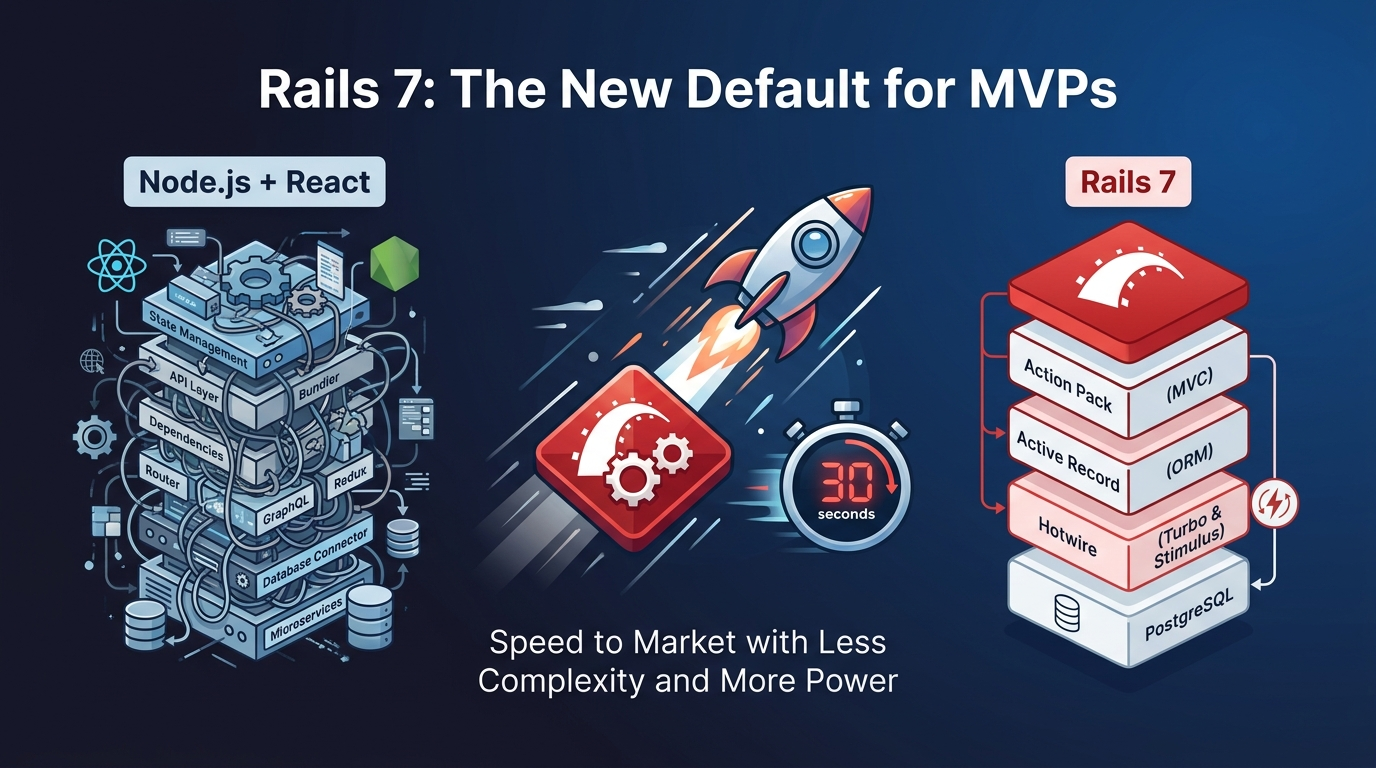
I have spoken to several founders building an MVP in React with a Node.js backend. They chose the modern stack
because that's what everyone talks about. Now they have a complex frontend for what's essentially a CRUD app with a few forms and a dashboard.
Three months in, they're dealing with Webpack configuration, API contract maintenance, and onboarding delays because new developers need to learn two separate codebases.
The problem is that the default
stack promoted by tech Twitter prioritizes buzzwords over actual productivity for early-stage products. Rails 7 has quietly become the most effective tool for getting products to market quickly without sacrificing modern developer experience.
The Question That Matters
Most founders ask What's the most popular stack?
The question that actually matters is What gets me to paying users fastest?
Rails 7 is optimized for the latter. It eliminates complexity rather than adding it. It's not the Rails of 2012 with its heavy asset pipeline. It's a modern framework that handles the 90% of functionality most MVPs need without forcing you to manage a separate frontend codebase.
1. Import Maps: No Node.js Required
Rails 7 lets you use modern JavaScript modules directly from the browser, without Webpack, without npm installs, without a node_modules folder.
# config/importmap.rb
pin "stimulus", to: "stimulus.js"
pin "hotwired/stimulus", to: "stimulus.js"
No package.json. No webpack.config.js. No fighting with build tools.
💡 Pro Tip: Run
rails new myapp --javascript=importmapto get this setup automatically.
What this means: Your team adds JavaScript functionality without understanding the Node ecosystem. You spend zero time configuring tooling and 100% time building features users pay for.
2. Hotwire: Reactive UI Without Building an API
The conventional wisdom says modern web apps need a separate frontend framework. But that separation comes with costs: two codebases, API contracts, authentication complexity, and slower onboarding.
Hotwire eliminates these costs. Here's a real-time notification with Turbo Streams:
<turbo-stream action="append" target="notifications">
  <template>
    <div class="notification">
      <%= @notification.message %>
    </div>
  </template>
</turbo-stream>
No WebSocket configuration. No Redis. No separate WebSocket server.
🔥 Hotwire in Action: Turbo Frames handle inline edits without page reloads. Turbo Streams push live updates. Stimulus gives you lightweight JavaScript when you need it.
What this means: You write half the code. No API contracts to maintain. Onboarding takes days instead of weeks. One codebase, one stack.
3. Dockerfile Out of the Box
Rails 7 generates a production-ready Dockerfile when you create your app:
FROM ruby:3.2-slim

RUN apt-get update -qq && \
    apt-get install -y --no-install-recommends \
    postgresql-client \
    nodejs

WORKDIR /app
COPY Gemfile Gemfile.lock ./
RUN bundle install
COPY . .

EXPOSE 3000
CMD ["rails", "server", "-b", "0.0.0.0"]
It's clean, minimal, and deploys anywhere—Fly.io, Render, or your own infrastructure.
🚀 Deployment Command:
fly launchthenfly deploy. Your app is live in under 5 minutes.
What this means: You're ready for production on day one. No it works on my machine.
No scrambling to figure out deployment when you're ready to launch.
The Economics of Stack Choice
| Factor | Rails 7 | Node.js + React |
|---|---|---|
| Time to first deploy | 30 minutes | 1–2 days |
| Lines of code (simple CRUD) | ~200 | ~800+ |
| Number of config files | 3 | 8–12 |
| Junior dev onboarding | 1 week | 3–4 weeks |
For early-stage startups, every week saved is runway extended. Rails consistently delivers 2–3x faster time-to-feature than React/Node stacks.
Real-World Validation
Companies like Shopify, GitHub, and Basecamp continue to build on Rails because it lets them move fast. Basecamp's HEY email service, built entirely with Hotwire, proves you can build reactive, modern interfaces without a separate JavaScript framework.
I've seen founders build and launch:
* A B2B SaaS dashboard in 10 days
* An internal tool for manufacturing scheduling in 2 weeks
* A marketplace in 3 weeks
All with Rails 7, all with paying users within a month.
When Rails Isn't the Answer
Rails isn't always the right choice. Consider alternatives if:
* Your product is primarily real-time collaborative like Figma or Google Docs
* Your team already has deep expertise in another stack
* You're building something that truly needs a native mobile app first
For the vast majority of B2B SaaS, internal tools, and marketplaces? Rails 7 is the most productive choice available today.
Getting Started
rails new my_mvp --css=bootstrap --database=postgresql --javascript=importmap
rails generate authentication
fly launch
fly deploy
You'll have a working, deployable app with user signup in under an hour.
Summary
The engineers who succeed at building MVPs aren't the ones who know the most frameworks. They're the ones who ship working software quickly, iterate based on user feedback, and make pragmatic decisions about complexity.
Rails 7 gives you that capability out of the box:
* Import maps eliminate Node.js complexity
* Hotwire provides reactive UI without a separate frontend
* Dockerfile means deployment from day one
When you're pre-product-market fit, your job is iteration speed. Every hour spent configuring Webpack or debugging API contracts is an hour not spent talking to customers.
Rails 7 eliminates those distractions. It's why it's become my default recommendation for anyone building an MVP.
Want to go deeper? In my next post, I'll walk through building a complete SaaS MVP in two weeks with Rails 7—including payments, background jobs, and deployment.

Leave a comment