You launched your MVP. People are paying. Now you have a different problem: growth.
Your app worked fine with 100 users. At 10,000 users, it's creaking. At 100,000, it's falling over.
Let me show you how to architect Rails for scale without rewriting everything.
The Journey
Scaling isn't about one big change. It's about many small improvements at the right time.
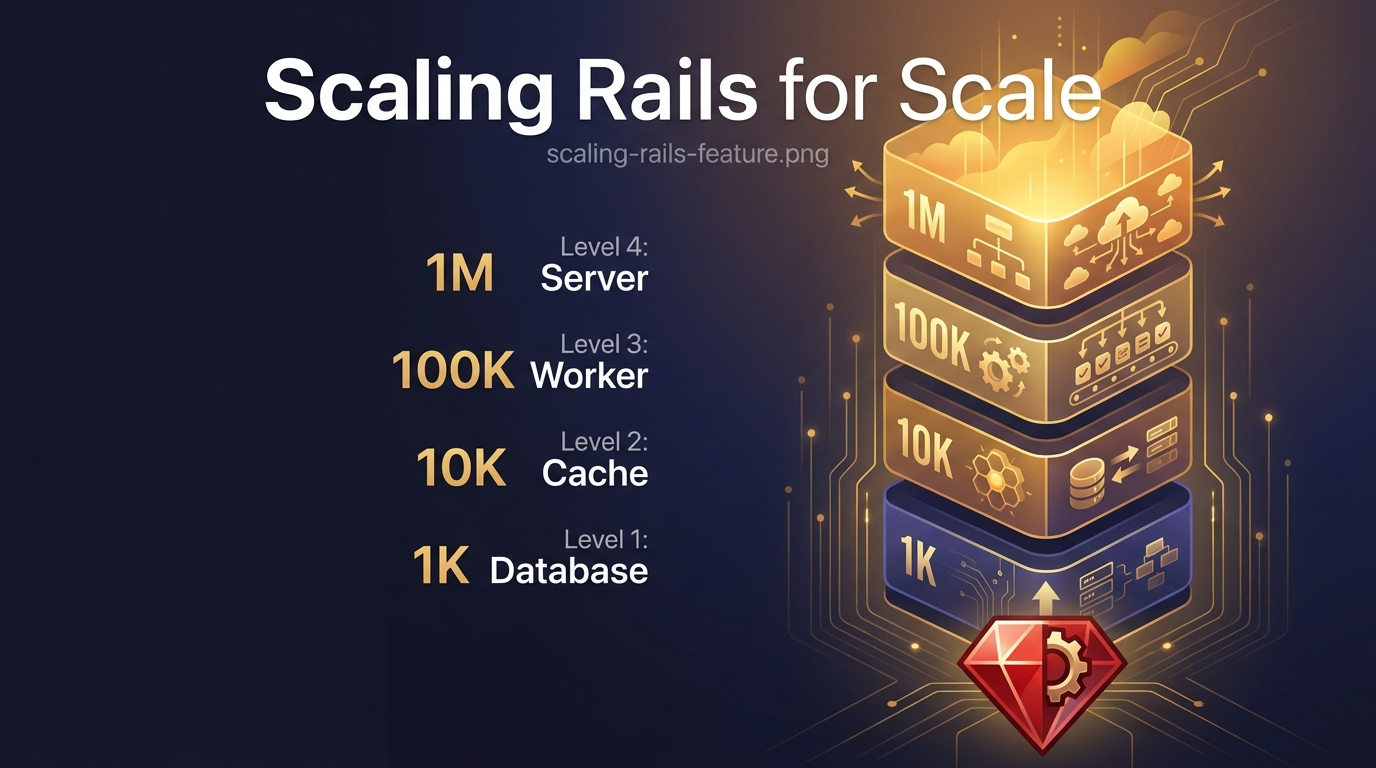
| Users | What Breaks First | What To Fix |
|---|---|---|
| 0 - 1,000 | Nothing | Ship features |
| 1,000 - 10,000 | Database queries | Add indexes, fix N+1 |
| 10,000 - 100,000 | Slow pages | Add caching |
| 100,000 - 1,000,000 | Background jobs | Queue everything |
| 1,000,000+ | Everything | Read replicas, sharding |
Don't optimize for a million users when you have ten. But know what's coming.
Phase 1: Clean Up Your Controllers
Before you scale infrastructure, scale your code organization.
The Fat Controller Problem
Most Rails apps start with everything in the controller:
# app/controllers/orders_controller.rb
class OrdersController < ApplicationController
  def create
    @order = Order.new(order_params)
    @order.user = current_user

    if @order.save
      # Send email
      OrderMailer.confirmation(@order).deliver_later

      # Update inventory
      @order.items.each do |item|
        item.update!(quantity: item.quantity - 1)
      end

      # Charge payment
      Stripe::Charge.create(
        amount: @order.total_cents,
        currency: "usd",
        source: params[:payment_token]
      )

      # Create invoice
      Invoice.create!(order: @order, user: current_user)

      # Send Slack notification
      SlackNotifier.notify("New order ##{@order.id}")

      redirect_to @order
    else
      render :new
    end
  end
end
This works. It's also impossible to test, debug, or understand six months later.
Service Objects
Extract business logic into service objects:
# app/services/order_creator.rb
class OrderCreator
  def initialize(user, order_params)
    @user = user
    @order_params = order_params
  end

  def call
    Order.transaction do
      create_order
      update_inventory
      charge_payment
      create_invoice
      send_notifications
    end
  rescue => e
    Rails.logger.error("Order creation failed: #{e.message}")
    false
  end

  private

  def create_order
    @order = @user.orders.build(@order_params)
    @order.save!
  end

  def update_inventory
    @order.items.each do |item|
      item.update!(quantity: item.quantity - 1)
    end
  end

  def charge_payment
    Stripe::Charge.create(
      amount: @order.total_cents,
      currency: "usd",
      source: @order_params[:payment_token]
    )
  end

  def create_invoice
    Invoice.create!(order: @order, user: @user)
  end

  def send_notifications
    OrderMailer.confirmation(@order).deliver_later
    SlackNotifier.notify("New order ##{@order.id}")
  end
end
Now your controller is simple:
# app/controllers/orders_controller.rb
class OrdersController < ApplicationController
  def create
    if OrderCreator.new(current_user, order_params).call
      redirect_to order_path(@order)
    else
      render :new
    end
  end
end
Concerns for Shared Logic
Use concerns for cross-cutting logic:
# app/models/concerns/archivable.rb
module Archivable
  extend ActiveSupport::Concern

  included do
    scope :active, -> { where(archived_at: nil) }
    scope :archived, -> { where.not(archived_at: nil) }
  end

  def archive
    update(archived_at: Time.current)
  end

  def unarchive
    update(archived_at: nil)
  end

  def archived?
    archived_at.present?
  end
end
Include it anywhere:
class Project < ApplicationRecord
  include Archivable
end

class User < ApplicationRecord
  include Archivable
end
Phase 2: Database Optimization
The database is usually your first bottleneck.
Add Indexes
Find slow queries:
# Enable logging in development
ActiveRecord::Base.logger = Logger.new(STDOUT)
Look for slow lines and add indexes:
class AddIndexesToOrders < ActiveRecord::Migration[7.0]
  def change
    add_index :orders, :user_id
    add_index :orders, :created_at
    add_index :orders, [:user_id, :created_at]
    add_index :users, :email, unique: true
  end
end
Fix N+1 Queries
# Bad - 1 + 100 queries
orders = Order.all
orders.each do |order|
  puts order.user.name
end

# Good - 2 queries total
orders = Order.includes(:user).all
orders.each do |order|
  puts order.user.name
end
Use the bullet gem to detect N+1:
# Gemfile
group :development, :test do
  gem "bullet"
end
# config/environments/development.rb
config.after_initialize do
  Bullet.enable = true
  Bullet.alert = true
  Bullet.rails_logger = true
end
Counter Caches
class AddCommentsCountToPosts < ActiveRecord::Migration[7.0]
  def change
    add_column :posts, :comments_count, :integer, default: 0
    Post.find_each { |post| Post.reset_counters(post.id, :comments) }
  end
end
class Comment < ApplicationRecord
  belongs_to :post, counter_cache: true
end
Phase 3: Caching
Russian Doll Caching
<%# app/views/posts/show.html.erb %>
<%= cache @post do %>
  <h1><%= @post.title %></h1>
  <%= @post.body %>

  <% @post.comments.each do |comment| %>
    <%= cache comment do %>
      <div class="comment">
        <strong><%= comment.author %></strong>
        <%= comment.body %>
      </div>
    <% end %>
  <% end %>
<% end %>
Low-Level Caching
class ReportGenerator
  def self.daily_sales(date)
    Rails.cache.fetch("daily_sales/#{date}", expires_in: 1.day) do
      Order.where(created_at: date.all_day).sum(:total_cents)
    end
  end
end
Phase 4: Background Jobs
What to Queue
- Emails
- Payments
- Reports
- File uploads
- External API calls
- Image processing
Solid Queue
class ReportGeneratorJob < ApplicationJob
  queue_as :default

  def perform(user_id, date_range)
    user = User.find(user_id)
    report = ReportService.generate(user, date_range)
    ReportMailer.ready(user, report).deliver_now
  end
end
ReportGeneratorJob.perform_later(current_user.id, Date.today..Date.today + 30)
Phase 5: Read Replicas
# config/database.yml
production:
  primary:
    database: myapp_production
    username: myapp
    password: <%= ENV["DATABASE_PASSWORD"] %>
  replica:
    database: myapp_production_replica
    username: myapp
    password: <%= ENV["REPLICA_PASSWORD"] %>
    replica: true
ActiveRecord::Base.connected_to(role: :reading) do
  User.where(active: true).count
end
Phase 6: Modular Monolith
Organize by feature:
app/
├── components/
│   ├── billing/
│   │   ├── app/
│   │   │   ├── controllers/
│   │   │   ├── models/
│   │   │   ├── services/
│   │   │   └── views/
│   │   └── billing_component.rb
│   ├── inventory/
│   │   └── inventory_component.rb
│   └── users/
│       └── users_component.rb
# app/components/billing/billing_component.rb
module Billing
  class Component
    def self.charge_user(user_id, amount)
      User.find(user_id).charge(amount)
    end

    def self.invoice_for(user_id)
      Invoice.where(user_id: user_id).last
    end
  end
end
Monitoring
Key Metrics
| Metric | What It Tells You |
|---|---|
| Response time | App speed |
| Error rate | Failures |
| DB query time | DB bottleneck |
| Queue size | Jobs backlog |
| Memory usage | Leaks |
| CPU usage | Compute bound |
Health check:
# config/routes.rb
get "/up", to: "health#show"
# app/controllers/health_controller.rb
class HealthController < ApplicationController
  def show
    ActiveRecord::Base.connection.execute("SELECT 1")
    Redis.current.ping
    render plain: "OK", status: :ok
  rescue => e
    render plain: "ERROR: #{e.message}", status: :internal_server_error
  end
end
Real-World Examples
- GitHub: Optimized monolith, millions of users
- Shopify: Indexing, caching, background jobs, read replicas
- Basecamp: Start simple, add complexity only when necessary
Scaling Checklist
At 1,000 Users
- [ ] Fix N+1 queries
- [ ] Add indexes
- [ ] Move logic to services
At 10,000 Users
- [ ] Russian doll caching
- [ ] Queue emails/jobs
- [ ] Monitoring setup
At 100,000 Users
- [ ] Read replicas
- [ ] Counter caches
- [ ] Rate limiting
At 1,000,000 Users
- [ ] Modular monolith
- [ ] Shard large tables
- [ ] Evaluate microservices
Summary
| Phase | Action |
|---|---|
| Code organization | Service objects, concerns |
| Database | Indexes, N+1 fixes, counter caches |
| Caching | Russian doll, low-level |
| Background | Solid Queue, Sidekiq |
| Database scaling | Read replicas |
| Architecture | Modular monolith |
Monitor. Measure. Improve.
Next post: Free Email Testing in Rails with RSpec

Leave a comment